Creating An Immersive and Equitable Religious Education Resource for Every School in Wales
Educator Gemma Zeeman is founder of Immersive Discoveries, and a Qualified Teacher who has taught from Reception to Year 6. She currently works as a Research Assistant on the Welsh Government–funded Wales Curriculum Learning Design (WCLD) project, supporting schools across Wales to integrate 360° imagery, AI and emerging technologies into everyday teaching.
In 2025 Immersive Discoveries was commissioned by Adnodd — the Welsh Government’s national education resources service — to create a digital Religions, Values and Ethics (RVE) resource for the Hwb digital learning platform, used by every school in Wales.
Book a free consultation
If you’d like to learn more about how your school or college can start creating immersive experiences that increase equity, accessibility and inclusion for all, schedule a free call with our Education Specialists.
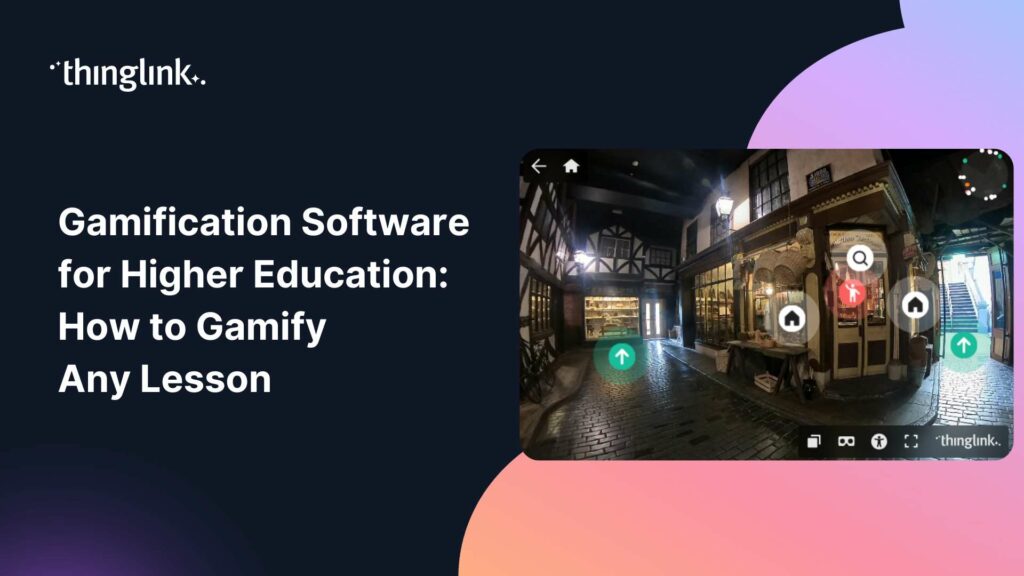
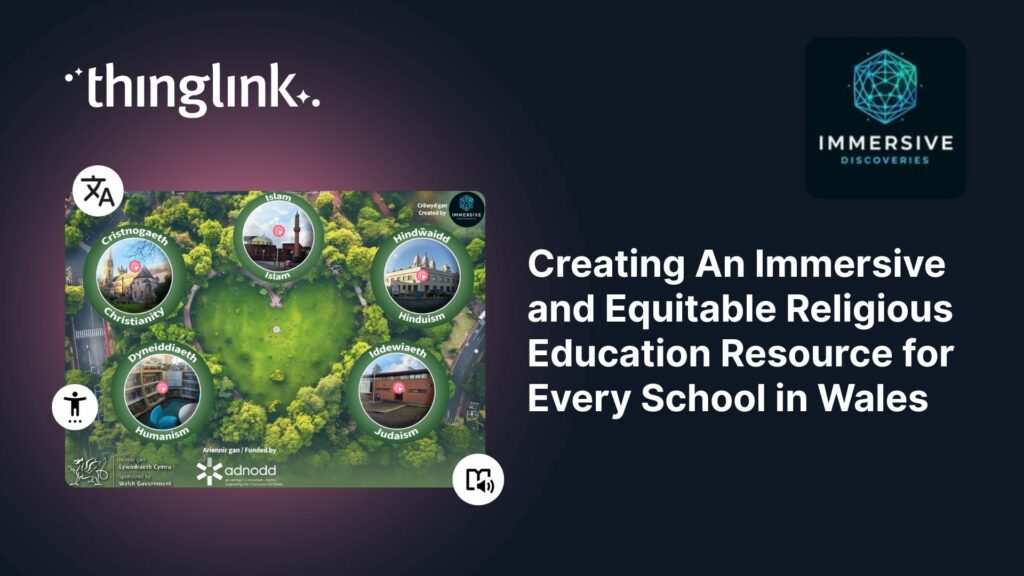
The resulting project is a set of immersive 360° learning environments covering four religious sites in Cardiff — a Hindu temple, a cathedral, a mosque, and a synagogue — alongside a section exploring Humanism, all within a single bilingual (Welsh/English) ThingLink virtual tour. Each site incorporates multiple linked immersive spaces, which can be moved through in any order. The scenes are augmented with rich interactive hotspots which contain combinations of explanatory text, video, audio narration provided by members of the faith communities, and other types of multimedia content. There are also embedded escape rooms within each site, designed as curriculum-linked knowledge tests. You can explore the entire experience below.
The Challenge
Religion, Values and Ethics (RVE) is a statutory part of the Humanities Area of Learning and Experience within the Curriculum for Wales. However Religious Education for school pupils presents a genuine equity problem. For pupils to encounter diverse faiths and world views, visits to places of worship are invaluable — but for many schools, such visits are simply out of reach, for any number of financial, geographical, and logistical reasons. For example, many schools in Wales are located in rural areas, where access to a diverse range of religious sites would be extremely difficult, time-intensive and costly to arrange.
Additionally, in an increasingly polarised political and religious climate, schools are increasingly experiencing reluctance — from parents, governors, and sometimes teachers themselves — around taking children to religious sites. For some schools therefore, the question is often not how to ensure a visit becomes a valuable learning experience, but whether that visit can even go ahead.
Given the costs and logistics involved in each individual field trip, they are of necessity a one-off event for each year group. This naturally means that if any child is absent on the day of the trip for any reason, they miss the experience. Even for those children who are able to attend, it would be highly unlikely that any school could afford four separate trips in any one year, requiring them to choose which site and faith to prioritise.
There can also be a gap in teacher confidence: some teachers feel insufficiently prepared or experienced when teaching faith traditions outside their own experience – and this hesitancy can translate into a reluctance to organise such field trips .
Each field trip itself is just one part of an overall learning experience, which requires classroom-based work both over the weeks leading up to it and the weeks afterwards. Relevant and curriculum-aligned resources are therefore also an invaluable and essential part of the entire learning experience for each school – but these can be extremely time-intensive to prepare.
Gemma’s brief required a solution that could reach every school in Wales equitably, work bilingually, and engage every pupil in meaningful learning — without requiring any school to navigate the logistical, financial, or political barriers of an in-person visit.
The Solution: An Immersive Experience that Ensures Access to Every Site, for Every Learner
From her experience with ThingLink and 360° cameras, Gemma identified the combination as an ideal fit for the brief. Places of worship are exactly the kind of spaces that benefit from the sense of presence that 360° images and videos create — and ThingLink’s layering capabilities allowed that presence to be transformed into structured, curriculum-aligned learning.
Gemma initially planned to work alone, with a bilingual teacher as Quality Assurance. When the brief expanded to include Humanism alongside the four faith traditions (Christianity, Hinduism, Islam and Judaism), she brought in two teachers as collaborators: Emma Richards and Lauren Riella. As well as being able to create the resource in a more time-efficient way, Gemma now had team members to discuss ideas with, challenge assumptions, and review content from different perspectives – resulting in a more robust resource overall.
The fifth belief system, Humanism, was an additional challenge. Parity is given in the Welsh Curriculum to Non-Religion but how do you go about designing an immersive space that doesn’t have a single physical presence? Linking to Humanism values a series of spaces were identified including a community library – the ideal place to represent the shared knowledge and learning, and shared understanding that Humanism encompasses. Alongside a Theatre, encompassing 360 degree music videos, science lab, woodland and The Senedd (Welsh Parliament).
Team Creative Collaboration
ThingLink’s collaborative environment was central to how the team worked. Having the whole team work in the same shared space — accessing, updating, and reviewing together in real time in a team account — made the creative process genuinely dynamic, allowing contributions to be seen and responded to immediately.
The team initially discussed and agreed upon a defined shared style guide, which included the main aspects of the religious sites which should be included in each part: Belief, Festivals, and Worship. In addition, they agreed upon the specific icons that should represent each type of content or transition, and how the tags should be laid out. This was key to ensuring a cohesive style, but more importantly provided a familiar structure which helped pupils and educators to navigate the resource more effectively.
In terms of hardware, the team used an Insta360 X4 camera, which was fully portable and could be set up with a simple tripod, and operated remotely via an on-phone app.
Representing Community Voices in an Authentic Way
Members of the faith communities themselves proved to be invaluable, active partners rather than passive sources. Faith leaders from each community actively reviewed the completed content to ensure it represented their community and beliefs accurately. In addition, they provided a personal introduction to and explanation of their faith, recorded by Gemmaon video, each structured and tailored to the 8-14 age group for which the learning experience was being created. These were then translated professionally into Welsh and dubbed.
Since April 2026 the resource has been freely available to every school in Wales through Adnodd and Hwb.
Benefits and Results
Pilot feedback from a Year 6 class
Prior to launch, the resource was piloted with a Year 6 class (aged 10-11). Across 35 responses, pupils gave an average rating of 4.1 out of 5. One-word descriptions included “fun,” “amazing,” “interesting,” and “immersive.” Pupils described the quality of presence the resource created: “it makes me feel like I am there” and “like I was actually there in real life.”
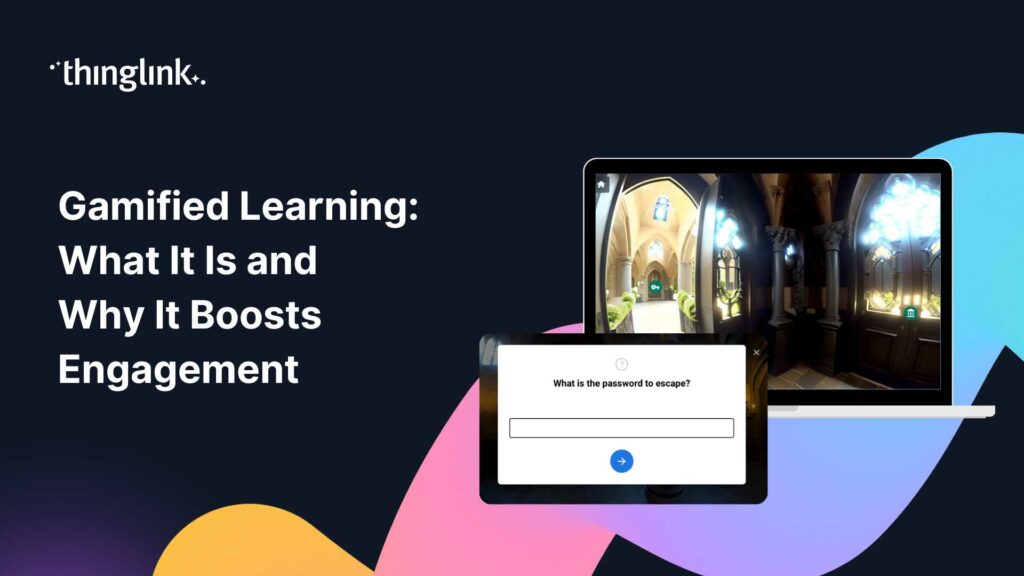
The escape rooms — interactive knowledge challenges embedded within each environment — proved even more powerful as an engagement mechanism than anticipated. As the class teacher observed, “the element of being locked really encouraged children to continue to explore the different rooms and learn new information.” The gamification layer turned exploration from passive browsing into purposeful investigation, deepening engagement and extending time on task.
The teacher who ran the pilot noted that the resource “acted as a great initial hook but also sustained pupils’ engagement for an entire session (and beyond)”, and praised its accessibility features — the immersive reader and language-toggle functions — as genuinely inclusive design. Other notable teacher feedback included:
- Pupils were adept at accessing the resource and exploring the different features. It is very user friendly!
- Pupils loved the 360 immersive elements – especially loved accessing these on the ipad – many of the pupils physically moved around the room as they explored the areas.
- Pupils also responded especially well to the ‘escape room‘ aspect – I loved this because they needed to answer questions to move to the next space which was a great way of ensuring they had read through the information!
- Pupils liked being able to control where they visited and how long they spent in each space – they liked the independence of their own navigation. This meant they could pace their own learning which is a good inclusive element.
- As a teacher I loved how the resource immediately grabbed pupils interest and enthusiasm.
- After the initial excitement pupils focussed well on the more detailed information and reading/comprehension was prompted by questioning features.
- The resource also prompted discussions and questioning about the different religions.
- This is a really engaging, interactive and genuinely immersive learning resource which is inclusive and accessible to all learners through the use of its various functions. Brilliant!
One pupil compared the immersive experience to a conventional school trip: “It is fun going on school trips but this is better because it’s free and faster.”
Additional Uses and Applications
Teachers in the pilot also suggested two additional ways in which the resource could be used, highlighting the way in which it fulfils the wider requirements of an experience of this type, beyond, before and after the trip itself:
- Pairing pupils who had attended a physical trip with those who hadn’t, giving both a shared list of things to find in the immersive environment — re-engaging those who missed the experience, and deepening understanding for those who were there. The resource also means that both teachers and pupils can revisit the sites to refresh their memory or to check facts and details – something which would naturally be harder if the trip were only physical.
- Supporting teacher confidence and lesson planning, allowing educators to familiarise themselves with unfamiliar faith traditions before teaching them. In this way the resource helps to support equity of experience between individual teachers and schools.
Book a free consultation
If you’d like to learn more about how your school or college can start creating immersive experiences that increase equity, accessibility and inclusion for all, schedule a free call with our Education Specialists.
Accessibility and Age Group Differentiation
The resource is designed to be comprehensively bilingual, with the English and Welsh versions easily toggled between, via the Translation icon in the bottom right of screen. This means that all content within the interactive tags is fully delivered in the correct language when the ThingLink is opened in English/Welsh. All videos have also been created in both languages, with captions. The bilingual toggle function was noted by teachers as a particular strength for mixed-language classrooms.
Additionally, the inclusion of Immersive Reader (a core ThingLink feature), also widens the suitability of the resource to younger pupils. Whilst it was initially designed for ages 8-14, teachers have reported that Immersive Reader’s Read Aloud function makes it easy to understand for younger pupils.
Conclusions
This exemplary learning resource is now removing cost, logistics, and community sensitivity as barriers to high-quality Religions, Values and Ethics Education for every learner. It allows each pupil to enter each space not as a guest or participant, but navigate and explore an educational environment about that space, at their own pace, with curriculum-aligned scaffolding.
The same approach translates directly to heritage organisations, cathedrals, and cultural bodies — where a single professionally built environment can serve visiting school groups and a wider digital visitor audience simultaneously.
“An immersive resource, accessed within the classroom, for places of worship provides a safe and accessible way for children to learn about different faiths, particularly in light of growing sensitivities around visiting religious sites in person. It also offers a cost-effective alternative for schools, enabling inclusive and meaningful religious education without the financial and logistical challenges of educational visits.”
Mathew R. Jones, Curriculum Tutor on the Postgraduate Certificate in Education (PGCE) Wales programme at the Open University and former headteacher
Contact
Immersive Discoveries creates bespoke 360° environments for education, heritage, and cultural organisations. To find out more, visit www.immersivediscoveries.co.uk