ThingLink Spotlight! Lighting Up Immersive Learning with Gustavo Vegas Haro
ThingLink Luminaries is a series of guest blog posts highlighting certified trainers who are creating interactive and immersive experiences to make learning more engaging, accessible, and meaningful. Our educators and learning designers bring a thoughtful approach to immersive learning, and their work reflects a deep commitment to creativity, pedagogy, and innovation.
In each profile post, we’ll explore their background, teaching philosophy, and favorite ThingLink projects offering insight into how they’re making a lasting impact in their classrooms, organizations and communities! Enjoy!
Introducing Gustavo!
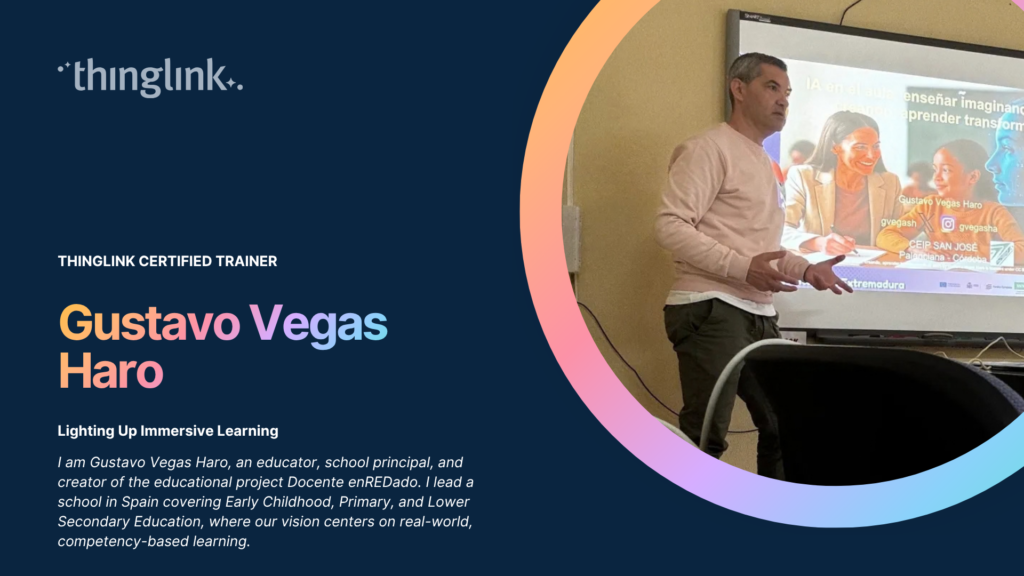
I am Gustavo Vegas Haro, an educator, school principal, and creator of the educational project Docente enREDado. I lead a school in Spain covering Early Childhood, Primary, and Lower Secondary Education, where our vision centers on real-world, competency-based learning.
My work focuses on driving meaningful digital transformation, leveraging Technologies for Empowerment and Participation (PETs), active methodologies, and the ethical integration of AI in education to empower students and support fellow teachers through training, publications, and collaborative networks.
Gustavo’s inspiring ThingLink project!
About this project
“Colegio Sostenible” is an interdisciplinary, competency-based learning scenario that engages students in environmental sustainability through real-world problem solving within their school community.
Hosted on a comprehensive Google Site and powered by a ThingLink interactive scenario, the project guides learners through decision-making pathways, 360° virtual spaces, and gamified dilemmas, using Technologies for Empowerment and Participation (PETs) to boost student agency, critical thinking, and ecological awareness.
What inspired you to create this project?
I was inspired by the firm belief that learning must be experiential, deeply connected to real life, and student-centered. I wanted to move away from passive tasks and create an environment where learners can actively construct their own learning pathways based on their personal interests, needs, and choices. “Colegio Sostenible” was born from the necessity to turn real-world environmental challenges into an engaging, interactive journey where students have true agency over their progress.
How was the project experienced by learners?
The Colegio Sostenible project was integrated into the primary education curriculum as an interactive simulation centered on environmental management. During the implementation phase, students were required to navigate a series of digital branching scenarios reflecting actual ecological challenges within the school grounds. Observational data indicated that the autonomy granted by the platform’s decision-making mechanics sustained student engagement throughout the module. Subsequent evaluations of the participating cohort showed a shift from theoretical memorization to applied competency.
The final submissions consisted of practical, site-specific solutions that closely aligned with the parameters established in the initial simulation, demonstrating an advanced mastery of the subject matter. Furthermore, the instructional design demonstrated measurable benefits for students with Specific Educational Support Needs. The incorporation of visual navigation pathways and integrated accessibility tools within the ThingLink environment resulted in higher rates of reading comprehension and active participation among this demographic when compared to standard pedagogical approaches.
What do you love about ThingLink?
The choice of ThingLink for developing these educational experiences is fundamentally based on its architectural flexibility and accessibility. The platform features an highly intuitive interface that removes technical barriers for both teachers and students.
This ease of use is a critical factor for designing multi-level educational resources activities with a “low floor and high ceiling” that accommodate diverse starting points while allowing for complex, advanced outcomes depending on the learner’s capacity. Because it supports multiple media formats within a single interactive space, the tool naturally aligns with Universal Design for Learning (UDL) principles. Educators can structure information in accessible layers, offering alternative means of representation and action that respond directly to the specific needs of different learners without diluting the core academic content.
Additionally, its interoperability plays a vital role in everyday classroom workflows. The interactive scenarios embed seamlessly into external learning management systems, websites, and platforms like Google Workspace. Simultaneously, it acts as a central hub where other digital tools and multimedia resources can be integrated directly into the tags, creating a unified and highly adaptable learning ecosystem rather than an isolated application.
Do you have any other projects on the go?
My work with ThingLink began in 2014, a timeline that has allowed me to continuously adapt its evolving features into my daily educational practice. Lately, my focus has been on developing comprehensive learning scenarios for the third cycle of primary education. One of the most engaging recent projects is “El Misterio del Tiempo” (link here), an interactive environment originally designed to contextualize historical concepts.
The current development phase involves transforming this specific project into a fully immersive expedition. The objective is to guide students through the major epochs of human history, requiring them to solve specific, contextualized challenges to progress along the timeline.
This branching narrative approach shifts the learning mechanics from simple observation to active, decision-based problem-solving. Looking toward broader applications, my ambition is to seamlessly blend structured open educational resources with these immersive environments. I am currently working on unifying a comprehensive learning scenario previously authored in eXeLearning (link here) directly into the ThingLink ecosystem. By merging the rigorous instructional framework of the original eXeLearning package with ThingLink’s multidimensional functionalities, the goal is to architect a cohesive space where structured curricular content and interactive visual exploration coexist naturally.
Gustavo’s Fun Fact!
I have been a dedicated advocate for educational innovation for years, not just within my own school but through extensive collaborations with teacher training centers, educational conferences, and online platforms. But beyond formal leadership and instructional design, I am driven by the belief that learning should be an active, hands-on experience which is why I’ve been experimenting with interactive platforms like ThingLink to build immersive “low floor, high ceiling” challenges, such as historical escape rooms and sustainability simulations, long before gamification became a standard classroom practice.
Thank you, Gustavo!
To connect with Gustavo and find out more about the fantastic projects he is involved in across Andalusia, Spain, take a look at his amazing website.