ThingLink Spotlight! Lighting Up Immersive Learning with Alexandre Torres
ThingLink Luminaries is a series of guest blog posts highlighting certified trainers who are creating interactive and immersive experiences to make learning more engaging, accessible, and meaningful. Our educators and learning designers bring a thoughtful approach to immersive learning, and their work reflects a deep commitment to creativity, pedagogy, and innovation.
In each profile post, we’ll explore their background, teaching philosophy, and favorite ThingLink projects offering insight into how they’re making a lasting impact in their classrooms, organizations and communities! Enjoy!
Would you like to become a ThingLink Certified Trainer?
If you’d like to learn more about the benefits of being part of our global ThingLink Certified Trainer community, check our page!
Leading the Way in Portugal: Introduction to Alexandre!
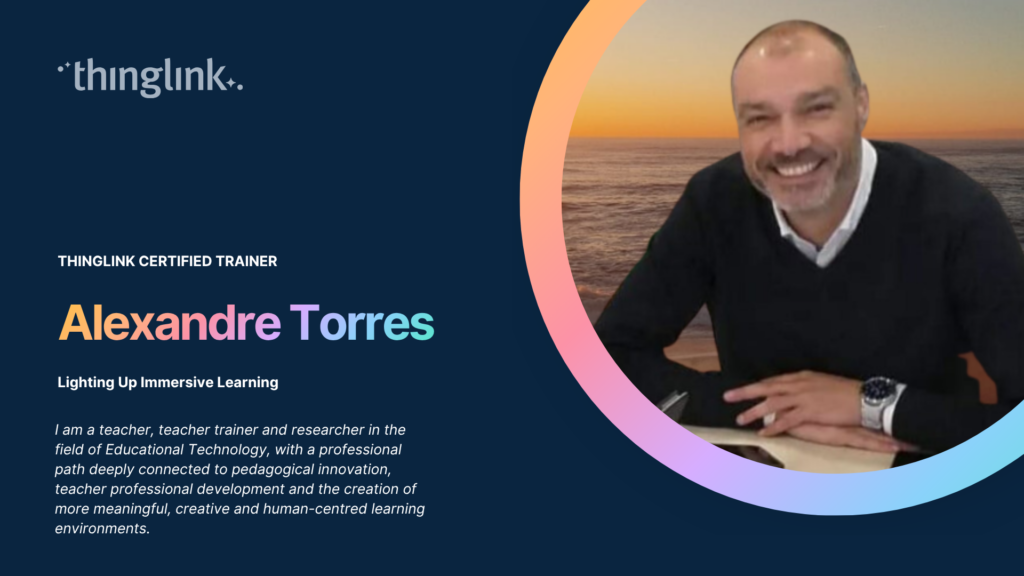
I am a teacher, teacher trainer and researcher in the field of Educational Technology, with a professional path deeply connected to pedagogical innovation, teacher professional development and the creation of more meaningful, creative and human-centred learning environments.
As a PhD candidate in Educational Sciences, specialising in Educational Technology, I have been developing research around the SMART Education Ecosystem, a project that seeks to connect space, technology, pedagogy and teaching in the design of innovative learning scenarios. I believe that technology only transforms education when it is guided by a clear pedagogical intention. For this reason, my work aims to challenge schools to move beyond pages, slides and linear learning paths, creating experiences that awaken curiosity, engagement and the desire to learn. Within this journey, ThingLink has played an important role by enabling the transformation of content, spaces and narratives into interactive and immersive experiences that bring students closer to knowledge in a more active and meaningful way.
Alexandre’s ThingLink Project
The project I am sharing through ThingLink is an interactive scenario dedicated to the SMART Education Ecosystem, where I present, in a visual, immersive and structured way, the main elements of the project: its vision, pillars, partners, pedagogical approaches and the underlying logic for designing innovative learning scenarios. More than simply presenting information, this scenario aims to show how ThingLink can transform a complex educational project into an exploratory experience.
Those who enter this environment do not just find texts or images; they discover pathways, connections, layers of meaning and opportunities for exploration. It is both a presentation of my project and a pedagogical provocation: what if we could bring together, in a single digital space, almost everything that gives life to an educational idea?
With the possibility of integrating interactive resources and, more recently, chatbot-supported experiences, ThingLink becomes a particularly fertile space for rethinking how we communicate, teach and engage learners. This scenario shows how technology can move beyond being a simple support tool and become an environment, a narrative and a form of pedagogical mediation.
What inspired you to create this project?
The inspiration for creating this project comes from a deep passion for education and from a concern that has accompanied me for many years: how can we continue to surprise students, awaken their curiosity and help them feel that learning can be a meaningful experience? Perhaps many of us still remember that immediate smile when, as students, a teacher entered the classroom with a large television. There was a promise of something different. Today, the challenge is different: our students already live in a visual, interactive and digital world, and schools need to offer learning experiences that connect with that reality, without losing rigour, intentionality and humanity.
This project was also inspired by an idea I once heard from Professor António Sampaio da Nóvoa: the need to create spaces that bring educational research produced in higher education closer to the real practice of teachers in schools. I felt that this was a central issue. Very often, a gap opens between what we study in initial teacher education and what we actually experience in the classroom. And this gap becomes wider when schools remain attached to models from the past, while students are students of the present — of today, not of yesterday, nor of an abstract tomorrow. It was in this context that the SMART Education Ecosystem was born: from the desire to think of the school as a living ecosystem, where space, technology, pedagogy and teaching come together to create smarter, more creative and more human learning scenarios.
Throughout the development of the project, I felt the need to explicitly value the Teaching pillar, because the act of teaching is absolutely fundamental. Space, technology and pedagogy were already being discussed, but it is the teacher — through the way they observe, decide, design, adapt, question and mediate — who transforms possibilities into real learning. Creating this scenario in ThingLink was therefore much more than building a digital presentation. It was a way of making an educational vision visible.
As I organised the project elements, partners, pillars, pedagogical approaches and possible pathways, I realised that ThingLink allowed me to transform a complex idea into an explorable environment, almost like a living map of the project. Each interactive point became an entryway to better understand the ecosystem. I deeply believe that teachers can make a difference. We are the ones helping to prepare tomorrow, but we do so with students who live in the present. For this reason, we cannot continue doing the same things and expect different responses. When teachers connect teaching with space, technology and pedagogy, teacher professional development emerges; and, for students, learning becomes more closely connected to the reality of their world. This is where innovation stops being just a discourse and becomes an experience.
How was the project shared and viewed?
This project was used as an interactive scenario to present and explore the SMART Education Ecosystem, allowing participants to discover, in a visual and non-linear way, its pillars, partners, pedagogical approaches and possible applications in real educational contexts. The experience became especially meaningful during the short training session dedicated to ThingLink, which also marked the launch of the ThingLink Portugal group.
The scenario worked as a practical example of how a complex educational idea can be transformed into an immersive, interactive and pedagogically meaningful experience. One of the main impacts was the enthusiasm generated among teachers and educators, who began to see ThingLink not merely as a digital tool, but as a possibility for designing learning scenarios, virtual visits, gamified pathways and interactive narratives. More than a presentation, this experience opened the door to the creation of a Portuguese community interested in exploring the pedagogical potential of ThingLink.
What do you love about ThingLink?
What I love most about using ThingLink is the way it gives context and meaning to digital resources. I have been using ThingLink for quite some time, and from the beginning I was fascinated by the possibility of connecting resources to images, 360° images and videos, without making them feel disconnected or decontextualised. Instead, everything becomes part of a visual and pedagogical narrative, where each interactive point has a purpose, a connection and a meaning.
For me, ThingLink can transform an image into a space for discovery. A resource is no longer simply “attached”; it becomes integrated into a learning pathway. This is essential, because it helps students explore, connect ideas and understand knowledge in a more meaningful way. I also love how the platform keeps evolving. With each new feature — captions, layers of information, integration of different resources, and more accessible and interactive experiences — my motivation to keep using it grows. I feel that ThingLink is not a closed tool; it is a learning environment in constant development, one that follows teachers’ pedagogical creativity and challenges us to imagine new ways of teaching and learning.
Do you have any other project ideas in development?
My greatest wish is to continue bringing ThingLink to more teachers involved in my SMART Education Ecosystem project and, more broadly, to teachers across Portugal who want to design more immersive, creative and meaningful learning experiences. I strongly believe in the potential of this platform to support the creation of educational scenarios, especially because it allows different resources to be integrated, 360° images to be explored and even experiences to be used with virtual reality headsets.
Whenever possible, I also try to include ThingLink in international courses and projects, such as Erasmus training programmes, because I believe it has a very powerful pedagogical language that can be easily understood and adapted by teachers from different contexts. However, the most special moment happens when we move beyond teachers creating scenarios and begin to see students themselves designing, building and developing their own projects in ThingLink. That is when learning reaches another level: students are no longer just explorers; they become authors. My dream is to see more and more students using ThingLink to investigate, tell stories, solve problems, create pathways and give shape to their own ideas, with no limits to their imagination.
Alexandre’s Fun Fact!
A fun fact about me is that I truly believe in the idea: “The more I learn, the more I realise how much there is still to discover.” Maybe that is why I am always searching for new ways to create, design, explore and reinvent learning experiences. For me, learning should never lose its sense of curiosity, imagination and joy — because some of the best ideas appear when we allow ourselves to learn while having fun.
Connect with Alexandre
Join us! If you are in Portugal and wish to be part of the ThingLink Community, we would love to welcome you. Please reach out to Alexandre directly.